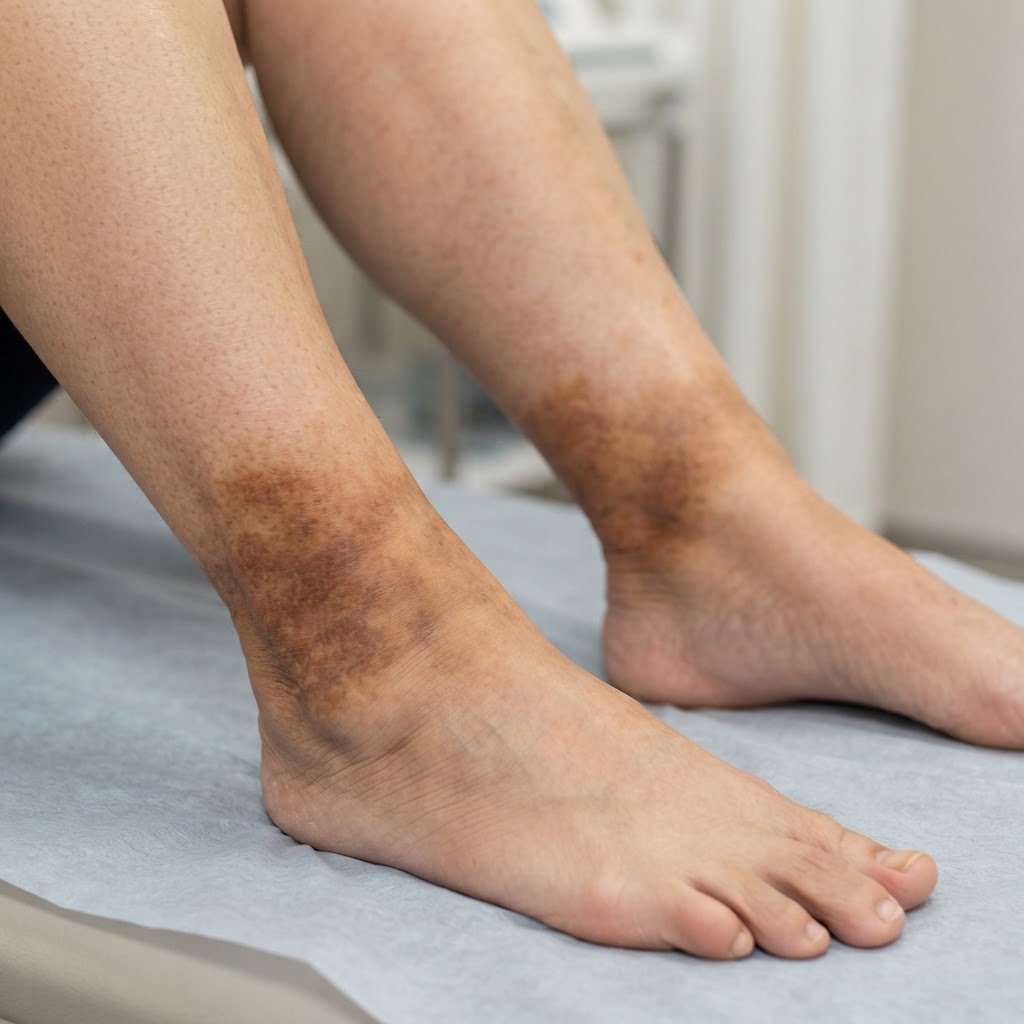
Brown or reddish discoloration around the ankles can be caused by hemosiderin staining, a buildup of iron-containing pigment in the skin. This may occur when chronic venous insufficiency causes increased pressure within the leg veins, allowing red blood cells to leak into surrounding tissue. As these cells break down, hemosiderin can accumulate, creating persistent brown pigmentation.
Not all ankle discoloration is caused by vein disease. However, when brown skin changes occur alongside swelling, itching, heaviness, or varicose veins, an underlying venous circulation problem should be considered.
What Is Hemosiderin Staining?
Hemosiderin staining is a form of skin pigmentation caused by deposits of an iron-containing substance called hemosiderin. When the valves in leg veins weaken or become damaged, blood may begin to flow in the wrong direction and accumulate in the lower legs. This is known as venous reflux and is a common mechanism of chronic venous insufficiency.
Over time, the increased pressure within the veins can affect the tiny blood vessels surrounding them. Red blood cells may escape into nearby tissue. As these cells break down, iron-containing pigment can remain behind, gradually changing the color of the skin.
What Does Hemosiderin Staining Look Like?
Is Brown Discoloration Around the Ankles a Sign of Advanced Vein Disease?
It can be. Medical professionals commonly use a classification system called CEAP to describe the clinical manifestations of chronic venous disease. Within this classification, pigmentation changes associated with chronic venous insufficiency fall under the C4 category.
How Is Brown Ankle Discoloration Caused by Vein Disease Treated?
Treatment should be based on the underlying diagnosis rather than skin appearance alone. If chronic venous insufficiency is identified, several management options may be considered, including compression therapy, leg elevation and physical activity, skin care, and minimally invasive vein treatment when diagnostic testing identifies clinically significant venous reflux.
Frequently Asked Questions
Brown ankle discoloration can have several causes, including hemosiderin staining associated with chronic venous insufficiency. Aging can increase the likelihood of developing venous disease, but persistent pigmentation should not automatically be dismissed as a normal part of getting older.
Yes. Underlying venous insufficiency can occur without large, visible varicose veins. Diagnostic ultrasound may help identify abnormal venous blood flow when clinically indicated.
Hemosiderin staining can be persistent and may not disappear completely, even after the underlying venous condition is treated. Outcomes vary depending on the cause, severity, and duration of the pigmentation.